DigestFlow Official Website › Blog › DigestFlow Interactions
What DigestFlow interactions should you plan for with drinks and other products?
DigestFlow interactions are mostly about adding things up. The capsule’s biggest ingredient is caffeine, and the products people already use every day tend to carry the same thing. This post covers drinks, foods and other supplements. Medicines have their own post.
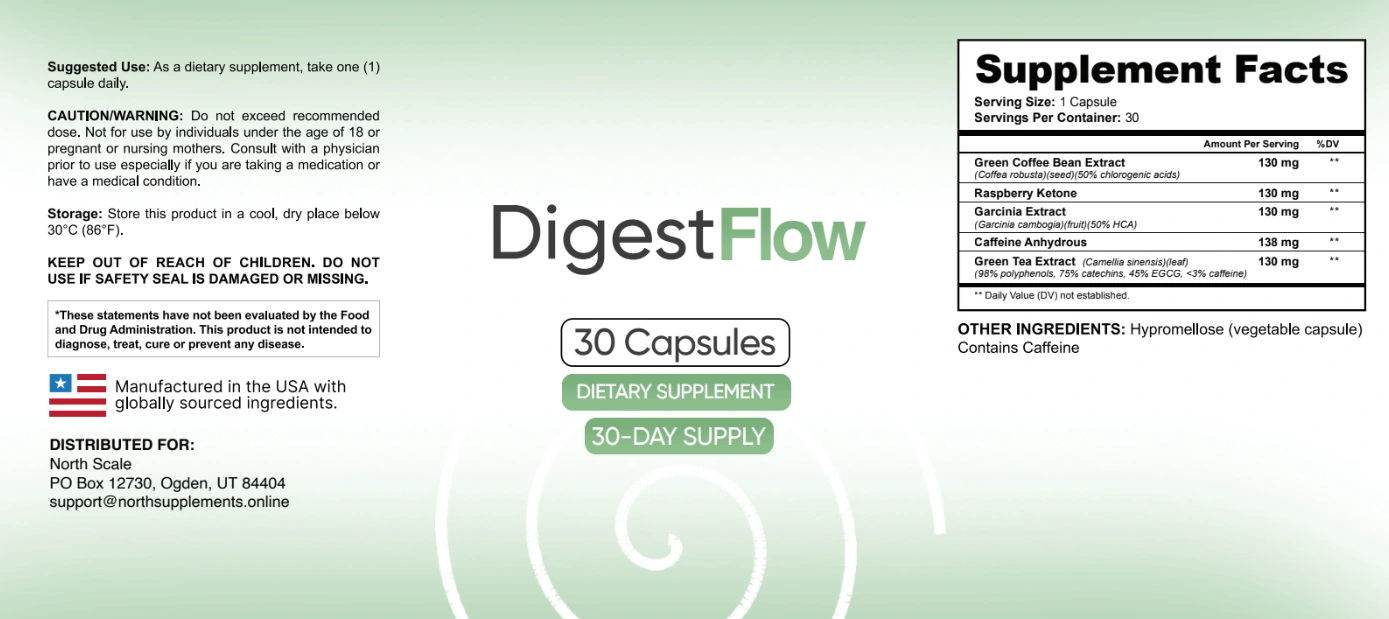
Quick answer: The DigestFlow interactions that matter most are additive. Each capsule has 138 mg of caffeine, so coffee, tea and energy drinks stack on top of it, and the FDA cites 400 mg a day for healthy adults. Other products with green tea extract or garcinia can stack too. No interaction testing of the finished capsule is published.
- Caffeine stacks: one capsule is 138 mg, and a day with three mugs of brewed coffee plus a capsule is about 423 mg.
- Green tea extract is in a great many products, so stacking it with another is a real risk to plan for.
- No fibre, probiotic, enzyme or laxative is on the panel, so nothing here bulks or binds.
- Take one capsule only. Two would be 276 mg of caffeine in one dose.
- Not published: any interaction study of the finished capsule with foods, drinks or other supplements.
What do DigestFlow interactions mean in plain terms?
An interaction is simply two things that change each other’s effect or add to each other’s. With this capsule, the commonest case is not exotic. It is a second source of the same ingredient. Caffeine is in coffee, tea, fizzy drinks, energy drinks and many pre-workout products. Green tea extract is in a long list of supplements. A day can quietly collect them all.
So the question to ask is not whether DigestFlow clashes with something strange. It is what else is already on your table. The next sections take the main groups in turn. If you take a prescribed medicine, ask a clinician too, and read DigestFlow side effects: 6 things to watch in the first week.
How do coffee, tea and energy drinks change DigestFlow interactions?
They add caffeine. The capsule figure is exact because the panel prints it. The drink figures are ordinary published ranges and move a great deal with brew strength and cup size.
| A day that already has | Approximate caffeine | Plus one capsule |
|---|---|---|
| One cup of tea | about 47 mg | about 185 mg |
| One mug of brewed coffee | about 95 mg | about 233 mg |
| Two mugs of brewed coffee | about 190 mg | about 328 mg |
| Three mugs of brewed coffee | about 285 mg | about 423 mg |
The FDA cites 400 mg a day as an amount not generally associated with negative effects in healthy adults.
Energy drinks and pre-workout powders are not in that table because their caffeine varies widely and is printed on their own labels. Read those labels and add the figure. The retailer’s side effects page puts it bluntly: 138 mg plus three coffees is over four hundred milligrams before lunch.
Can you stack DigestFlow with other products containing green tea extract or garcinia?
This is the interaction the retailer asks you to hold in mind. Green tea extract is a very common ingredient, and the liver case literature attaches to concentrated extracts at large daily amounts, often taken fasted. This capsule carries about 59 mg of EGCG, well below the region those reviews describe. A second product with its own green tea extract changes that sum.
Garcinia works the same way. Published liver case reports attach to garcinia products, mostly multi-ingredient products at higher doses. If you already take another weight, energy or digestive product, look for green tea extract, garcinia, green coffee and caffeine on its label first. If any appear, you are stacking, and the sensible step is to pause one of them and ask a clinician.
What about food and DigestFlow interactions?
The label does not give a food instruction. The retailer’s advice is to take the capsule in the morning with water, and a little food is a sensible default, because an empty stomach makes the arrival of the caffeine sharper for people who are not used to it. That is advice about comfort, not a tested food interaction.
Nothing on the panel is a fibre or a bulking agent, so the usual advice about spacing a fibre supplement from other things does not apply for that reason. No study of the finished capsule with particular foods is published. If you notice a pattern, such as a jittery half-hour on an empty stomach, write it down. That is the sort of note that helps a clinician later.
Check, then decide at your own pace
Once your day’s caffeine adds up, the order page shows the price and the guarantee before you pay.
See today's price and guaranteeDisclosure: this website is a retailer and earns on the packs it sells. The checkout shows the amount you pay.
Do DigestFlow interactions include other digestive products?
They can, in a practical sense. DigestFlow is not a probiotic, not a digestive enzyme, not a fibre and not a laxative. So adding one of those would not duplicate an ingredient, and the retailer does not list a clash. But a second product aimed at the same symptoms makes it hard to tell which one did what.
The retailer’s own testing advice is to change nothing else deliberately for the first fortnight. If you start a fibre product, a new diet and a capsule in the same week, you will not know which one did anything. The post DigestFlow dosage: how many a day and when to take it explains the one-capsule routine.
Can you double up on DigestFlow to offset a missed day or a heavy meal?
No. The label says do not exceed recommended dose, and the recommended dose is one capsule. Two would be 276 mg of caffeine in a single hit, and the retailer calls that out directly. A missed day matters far less than a moving schedule.
The same logic covers adding a second caffeinated product to make up for a quiet day. Stacking is how a modest capsule turns into a long evening. The side effects page lists the caffeine effects and the liver warning signs together.
What is not published about DigestFlow interactions?
Be clear about the blanks. There is no study of the finished capsule with foods, drinks or other supplements. There is no tested list of products to avoid. There is no certificate of analysis. And there is no caffeine-free version listed. What is published is the full panel, which lets you do the addition yourself.
That makes you the main safety check. Add up the caffeine, check other labels for green tea extract and garcinia, keep to one capsule and ask a clinician if you are unsure. It takes ten minutes and it covers most of what the phrase DigestFlow interactions can mean.
Where do these facts come from?
Label figures come from the printed artwork. Prices and policy terms come from the order paperwork, read on 19 September 2026. Reference points come from sources this website already cites:
- The FDA’s own caffeine guidance: https://www.fda.gov/consumers/consumer-updates/spilling-beans-how-much-caffeine-too-much
- MedlinePlus on constipation, a plain-language page on digestive symptoms: https://medlineplus.gov/constipation.html
- NCCIH on dietary and herbal supplements: https://www.nccih.nih.gov/health/dietary-and-herbal-supplements
Frequently asked questions
Does DigestFlow interact with coffee?
It adds to it. One capsule is 138 mg of caffeine, and three mugs of brewed coffee plus a capsule is about 423 mg, over the 400 mg a day FDA reference.
Can I take DigestFlow with another green tea product?
Be careful. Green tea extract is common, and stacking it raises your daily intake of concentrated extract. Check the other label first.
Does DigestFlow interact with fibre or probiotics?
The panel has no fibre and no probiotic, and the retailer lists no clash. Starting several things at once makes results hard to read.
Should I take it on an empty stomach?
The label does not say. A little food is the sensible default for a capsule carrying this much caffeine.
Is there an interaction study of the capsule?
Not published. No trial of the finished capsule exists.
Can I take two capsules if I miss one?
No. Two capsules would be 276 mg of caffeine in one dose, and the label says not to exceed the recommended dose.
Our view
Most DigestFlow interactions are additions, not clashes. The capsule is 138 mg of caffeine plus four extracts, and the products around it, coffee, tea, energy drinks and other supplements, often carry the same things. A small sum with a pen shows you where you stand.
No interaction testing of the finished capsule is published, so the sum and your clinician are the safety check. If the total looks high, change the other products first. The capsule is the easiest thing in your day to leave out.
Ready to look at the real terms?
Do the addition first. The order page then shows the packs and the 60-day wording.
See today's price and guaranteeDisclosure: this website is a retailer and earns on the packs it sells. The checkout shows the amount you pay.
Last updated . Medically reviewed by Dr. Will Bulsiewicz, MD, Physician.