DigestFlow Official Website › Digestive Supplement Guide
Digestive Supplement GuideA Digestive Supplement Guide: What The Categories Actually Do
Digestive supplements fall into five groups, and they work in completely different ways.
Fibres add bulk and hold water. Enzymes act on a meal. Probiotics add organisms. Bitters and carminatives act on secretion and on gas. Stimulants act on motility. Knowing which group a bottle belongs to answers most of what a label will not.
A guide to the shelf rather than to one product, written so that a reader who ends up buying nothing from this desk has still got something out of the visit.
The five groups, and what each one is for
| Group | How it acts | Typical form | What it is poor at |
|---|---|---|---|
| Soluble and insoluble fibre | Adds bulk and holds water in the bowel | Psyllium, inulin, glucomannan, by the gram | Acting fast, and being pleasant to take |
| Digestive enzymes | Acts on the meal in the gut rather than on the body | Protease, lipase, amylase, lactase, with food | Doing anything at all between meals |
| Probiotics | Adds live organisms, strain by strain | Capsules with a CFU count and named strains | Generalising. The evidence is strain-specific and narrow |
| Bitters and carminatives | Traditional actions on secretion and on trapped gas | Ginger, peppermint, fennel, gentian | Producing modern trial evidence |
| Stimulants | Acts on motility, sometimes forcefully | Senna, cascara, magnesium salts, caffeine | Being taken indefinitely without consequence |
A map of mechanisms, not a ranking. Most of the disappointment in this category comes from buying one group while expecting another.
The first thing to do with any bottle is to work out which row it belongs to. It is usually obvious from the panel and almost never obvious from the front label, which is written to appeal rather than to classify.
The NIDDK explainer on how digestion works is the background worth having before any of this, because a mechanism only makes sense against the process it is supposed to be affecting.
What the evidence looks like in each group
The quality of the evidence varies enormously across those five rows, and a buyer is better served by knowing where the good evidence is than by a ranking of brands.
Fibre: the best-evidenced and the least marketed
Decades of work, a plausible and simple mechanism, and a cost of pennies a day. It is also unglamorous, tastes of nothing much and has to be taken with enough water to matter, which is why it is rarely the thing a supplement page is selling.
Probiotics: real, and narrower than the marketing
NCCIH is candid that effects are specific to strain, dose and condition, and that a result for one strain says very little about another. A panel naming a genus without a strain is not telling you enough to look anything up.
Enzymes: narrow and well defined
Lactase for lactose is the clearest case in the whole category: a known deficiency, a known substrate, a known fix. Broad-spectrum enzyme blends for general discomfort are a much weaker proposition and are sold far more widely.
Stimulants: effective and not for every day
Caffeine's effect on colonic activity was measured directly in humans and is real. Anthraquinone laxatives are more forceful again. Both work; neither is a long-term answer to a symptom nobody has explained yet.
Reading a digestive supplement panel in four minutes
- Find the serving size first. Every other number on the panel is per serving, and a two-capsule serving on a sixty-capsule bottle is a month, not two.
- Look for a proprietary blend. One weight covering several names means you cannot know any of them. The total is a ceiling, and nothing in it can exceed it.
- Read the standardisation, not just the plant weight. A 500 mg extract at 5 per cent is 25 mg of the thing the research is about.
- Check for caffeine, in any of its disguises. It appears as caffeine anhydrous, inside green tea and guarana rows, and sometimes only as a Contains Caffeine line.
- Read the other-ingredients line. The capsule shell lives there, and so does the answer to the vegetarian question.
- Then look up one ingredient. Not all of them. The largest row, at the dose printed, for the outcome on the front of the bottle.
Multiply the row weight by the standardisation percentage before comparing anything to a study. Most of the distance between a label and a trial in this category lives in that one piece of arithmetic.
What no digestive supplement can do
This is the section a category guide owes its readers, and it is short.
No supplement in any of the five groups can tell you why a symptom is there. Several quite different conditions produce similar complaints, and the NIDDK page on irritable bowel syndrome is a good illustration of how much overlap there is between things that need very different answers.
Bleeding, unexplained weight change, persistent pain, fever, difficulty swallowing or a change that has lasted more than a few weeks are all reasons to be examined rather than supplemented. That is not a disclaimer added for form's sake; it is the most useful sentence on this page for the small proportion of readers it applies to.
NCCIH on dietary and herbal supplements is a fair general primer on how to weigh any of this, and it is written for readers rather than for advertisers.
A short glossary for this shelf
| Term | What it means | Why it matters |
|---|---|---|
| CFU | Colony forming units, the count of live organisms | A probiotic without one is not telling you the dose |
| Standardised to | A guaranteed percentage of a named compound | Turns an extract weight into a comparable dose |
| Proprietary blend | Several ingredients under one total | Makes every individual weight unknowable |
| Anhydrous | Water removed, so the powder is the pure compound | Caffeine anhydrous is caffeine, at the weight printed |
| Hypromellose | A plant cellulose used for capsule shells | The usual vegetarian alternative to gelatin |
| Daily Value not established | No official reference intake exists for that substance | Normal for botanicals. It is not a criticism |
| Prebiotic | A substrate that feeds resident organisms | Different from a probiotic, and often confused with it |
Seven terms that cover most of what a panel in this aisle will throw at a reader.
Sources for this digestive supplement guide
Agency pages and human studies, none of them about any particular product.
- National Institute of Diabetes and Digestive and Kidney Diseases. Your Digestive System and How It Works. https://www.niddk.nih.gov/health-information/digestive-diseases/digestive-system-how-it-works
- National Institute of Diabetes and Digestive and Kidney Diseases. Irritable Bowel Syndrome (IBS). https://www.niddk.nih.gov/health-information/digestive-diseases/irritable-bowel-syndrome
- National Center for Complementary and Integrative Health. Probiotics: What You Need To Know. https://www.nccih.nih.gov/health/probiotics-what-you-need-to-know
- National Center for Complementary and Integrative Health. Dietary and Herbal Supplements. https://www.nccih.nih.gov/health/dietary-and-herbal-supplements
- Rao SS, Welcher K, Zimmerman B, Read N. Is coffee a colonic stimulant? Eur J Gastroenterol Hepatol. 1998;10(2):113-8. PMID 9581985. https://pubmed.ncbi.nlm.nih.gov/9581985/
- Latthe A, Tan A, Latthe P. The Effectiveness of Caffeine in Reducing Constipation in Adults: A Systematic Review. Int Urogynecol J. 2025;36(2):253-264. PMID 39666017. https://pubmed.ncbi.nlm.nih.gov/39666017/
- National Institutes of Health, Office of Dietary Supplements. Dietary Supplements for Weight Loss: Health Professional Fact Sheet. https://ods.od.nih.gov/factsheets/WeightLoss-HealthProfessional/

Where DigestFlow sits on that shelf
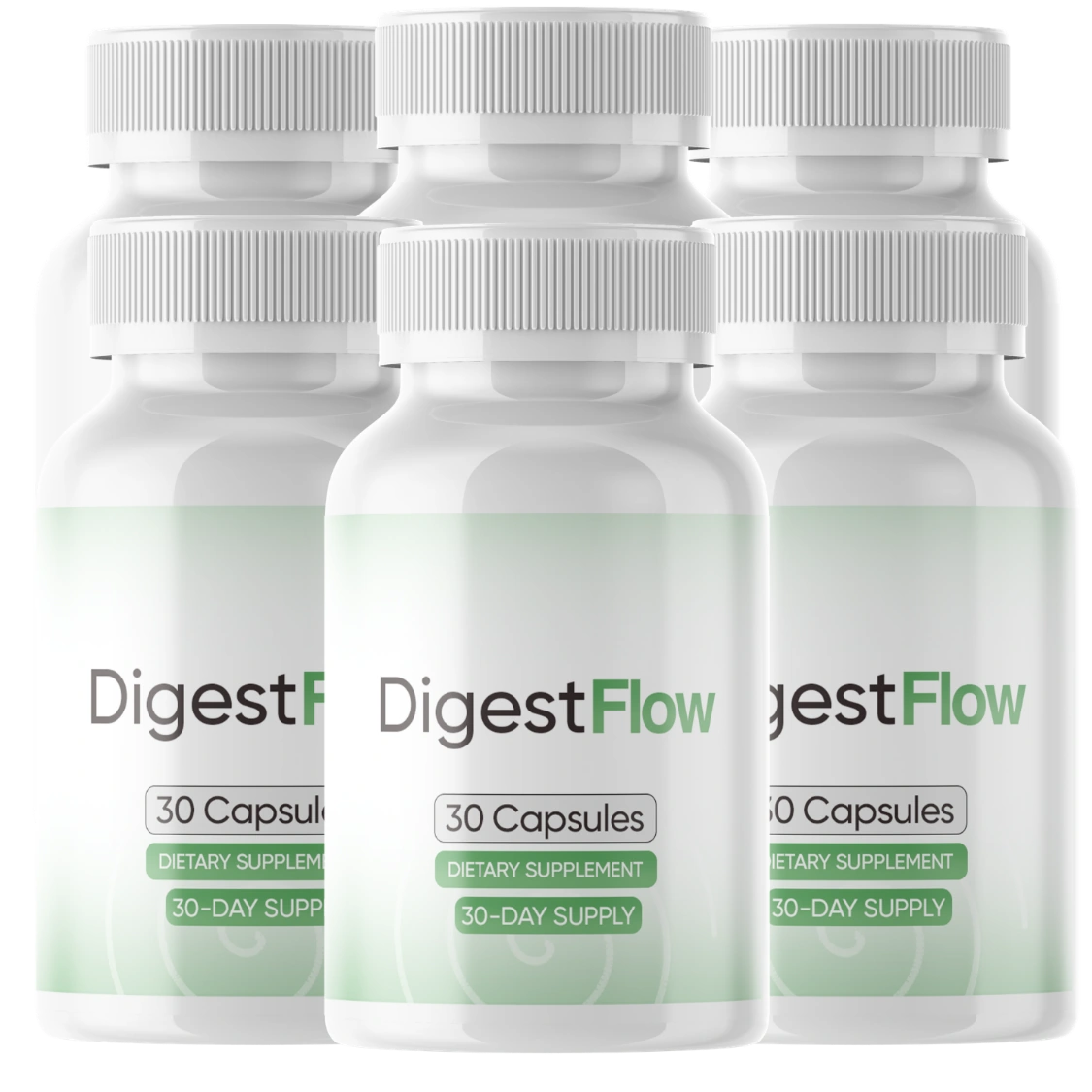
One capsule a day, five printed actives, and one stimulant row with human evidence behind it. The panel is on the ingredients page.
Two bottles $158 · six bottles $294 · 60 days from purchase
Order DigestFlow On The Official WebsiteOne capsule a day · 30 per bottle · lot DIG-26/GO-2148