DigestFlow Official Website › Blog › Why A Gut Capsule Carries 138 mg Of Caffeine
Why A Gut Capsule Carries 138 mg Of Caffeine
It is the largest row on the DigestFlow panel and the one nobody puts on the front of a box. It is also, by a distance, the ingredient on that label with the best claim to doing something in the intestine. Both of those are worth explaining.
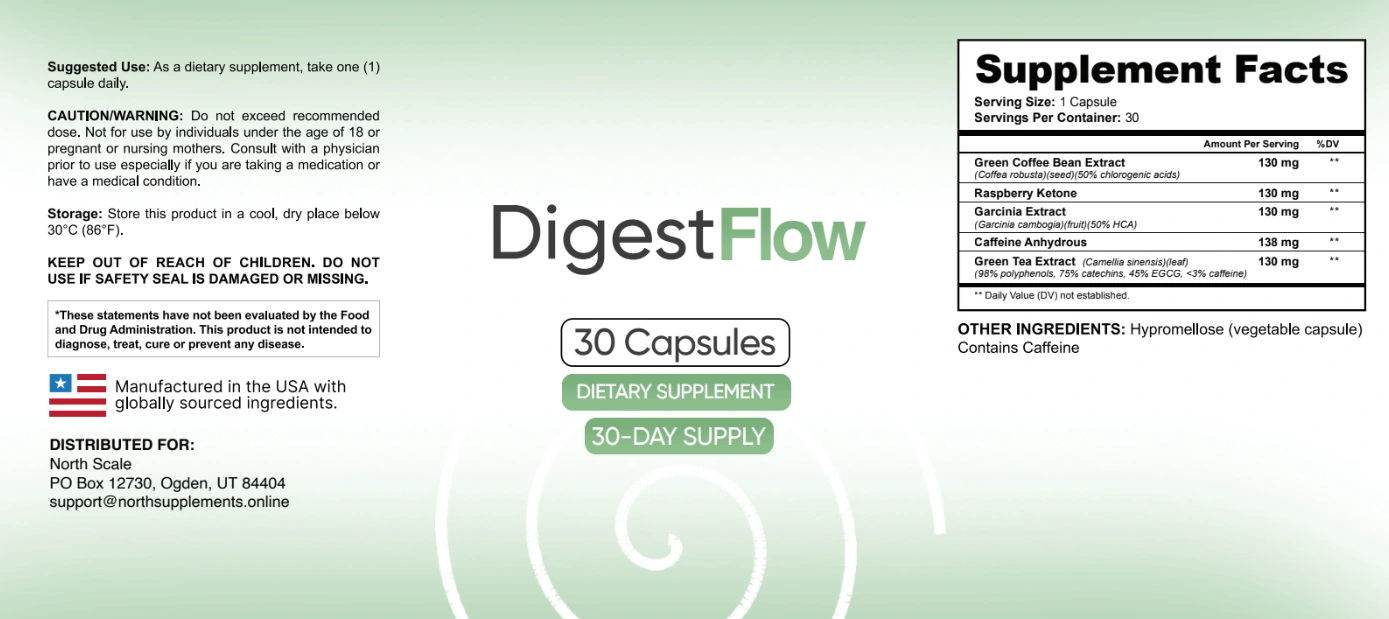
- One capsule carries 138 mg of caffeine anhydrous, printed on its own panel row.
- That is roughly a large mug of brewed coffee, in a bottle taken every day.
- Caffeine raises colonic motor activity in human studies, within minutes.
- It is the only row on this panel with a directly measured effect on the intestine.
- The cost is sleep, and the fix is taking the capsule before midday.
- The FDA puts 400 mg a day as the level not generally associated with negative effects in healthy adults, so one capsule is about a third of it before anything you drink.
What 138 mg actually is
Caffeine anhydrous is caffeine with the water removed. It is a dry, standardised powder, which is why a capsule can carry an exact weight of it and a leaf or a bean cannot. The 138 mg on this panel is therefore a real number rather than an estimate from a plant extract, and it is one of the very few figures in the supplement aisle that means precisely what it says.
Put beside the things people already drink, it is unremarkable in size and remarkable in consistency. A mug of coffee might be 95 mg or 165 mg depending on the bean, the grind, the water and the size of the mug. A capsule is 138 mg on Monday and 138 mg in March.
That consistency is the whole practical difference. Somebody who takes this capsule every morning is administering a fixed dose of a well-studied stimulant at a fixed time, which is a far better-defined intervention than most supplement routines manage.
| Source | Typical caffeine | How it compares with one capsule |
|---|---|---|
| One DigestFlow capsule | 138 mg | The reference point for this table |
| A 12 oz mug of brewed coffee | about 95 to 165 mg | Roughly the same order |
| A double espresso | about 125 mg | Roughly the same order |
| A mug of black tea | about 47 mg | About a third |
| A 12 oz cola | about 34 mg | About a quarter |
| A 16 oz energy drink | about 160 mg | Slightly more |
| A cup of green tea | about 28 mg | About a fifth |
Drink figures are ordinary published ranges and move enormously with brew strength and cup size. The capsule figure is exact, because the panel prints it.
Two things follow from that table and both are simple. If your day currently has no caffeine in it, this capsule adds roughly one coffee. If your day already has three coffees in it, this capsule is a fourth, and the interesting question stops being about the gut and starts being about the total.
What caffeine does to the large bowel
This is where the evidence sits, and it is older and better than most of what gets cited in this category. Rao and colleagues put pressure sensors into the colon and measured what happened after a drink. Coffee raised colonic motor activity within four minutes, the effect was still present half an hour later, and it was stronger than the response to water.
Four minutes is fast. It is faster than anything could be absorbed, digested and delivered by the bloodstream, which tells you the effect is at least partly a reflex rather than a slow pharmacological action. That detail matters because it is the kind of finding that is hard to explain away.
Since then the question has been whether the effect is useful rather than merely real. A 2025 systematic review gathered what has been published on caffeine and constipation in adults. A randomised trial in surgery went further and tested caffeine deliberately, as an intervention for restoring bowel function after laparoscopic colectomy, which is a setting where slow transit is a measurable clinical problem.
What that evidence is not
- It is not a study of this capsule. Nothing has tested DigestFlow as a finished product.
- It is mostly work on coffee rather than on isolated caffeine, and coffee carries hundreds of other compounds.
- It does not establish that caffeine treats any condition, and no supplement may claim that it does.
- It says nothing about the other four rows on the panel, which is the subject of the next section.
Why it is the most defensible row on this panel
Sort the five rows by how close their evidence sits to the organ this product is sold for, and the order comes out differently from the order the panel prints.
| Panel row | Per capsule | Kind of evidence behind it | Relevance to the gut |
|---|---|---|---|
| Caffeine anhydrous | 138 mg | Human studies with direct measurement | Direct: colonic pressure activity rises within minutes |
| Green coffee bean extract | 130 mg | Human trials, one of them retracted | Indirect: the acids are largely metabolised in the colon |
| Green tea extract | 130 mg | Human trials, mostly on energy expenditure | Indirect: the catechins reach the colon in the same way |
| Garcinia extract | 130 mg | A large null human trial at a far higher dose | None proposed |
| Raspberry ketone | 130 mg | Rodent work only | None proposed |
Sorted by how close the evidence sits to the organ the product is sold for, which is not the order the panel prints them in.
That table is the honest structure of this label. One row has direct human evidence in the right organ. Two have indirect relevance, in that their compounds demonstrably arrive in the colon even though nobody has measured what they do once they get there. Two have no proposed digestive mechanism at all and are on the panel because they belong to a familiar ingredient set.
None of that makes the product a fraud. It makes it a formula with one plausible engine and four passengers, and a buyer who knows which is which can judge it properly. A buyer who has been told all five work together on digestion has been sold a story the panel does not support.
Its best-evidenced ingredient is the one that is also in coffee, at roughly the dose that is in coffee. That is not a criticism of the capsule. It is a reason to know what you are buying, and to notice that the seller declared it rather than hiding it inside a botanical row.
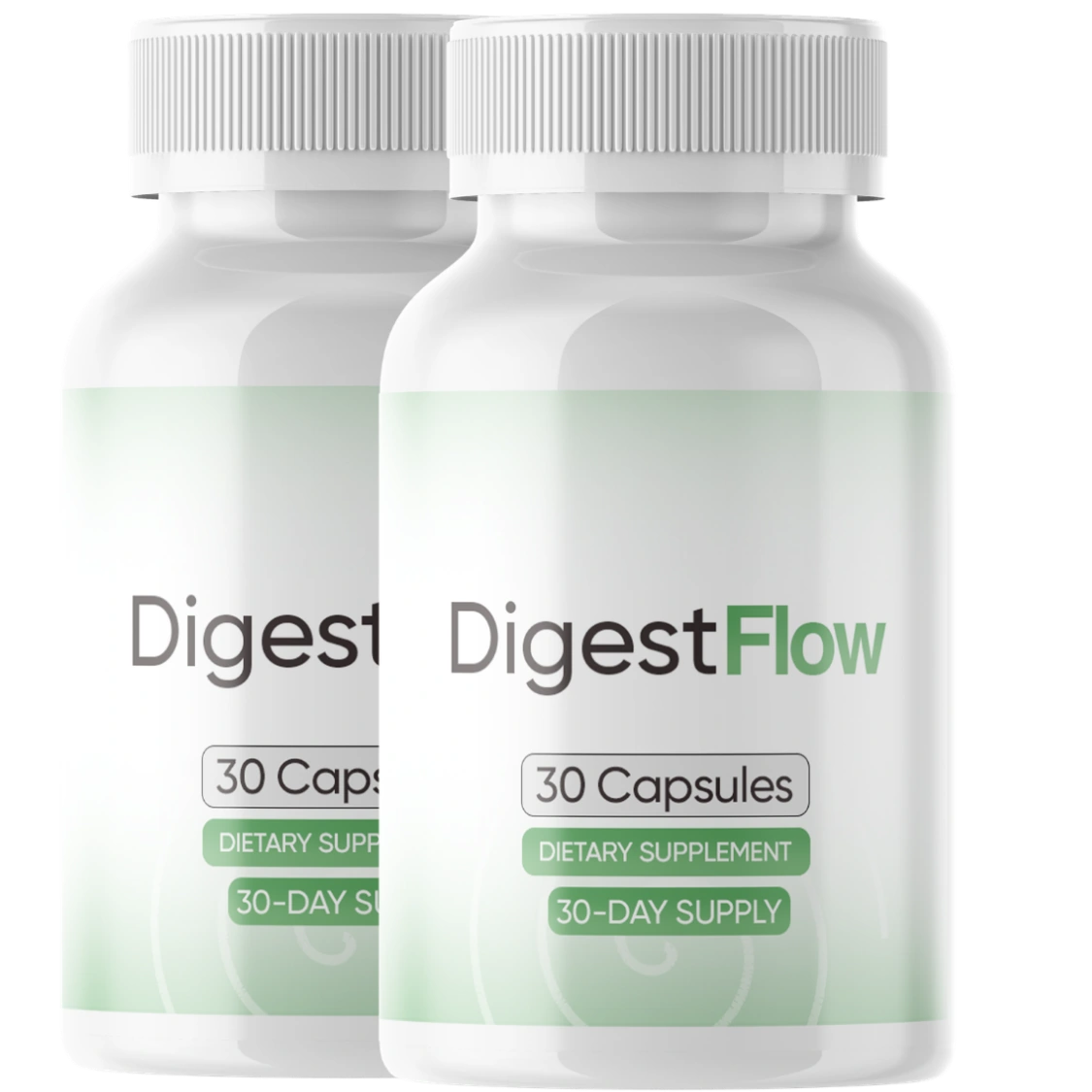
DigestFlow prints the caffeine figure rather than hiding it
138 mg on the panel and a separate Contains Caffeine line. Read the whole label before you decide, and keep the sixty days in reserve.
Two bottles $158 · six bottles $294 · 60 days from purchase
Order DigestFlow On The Official WebsiteOne capsule a day · 30 per bottle · lot DIG-26/GO-2148
The cost, and it is sleep
Every stimulant has a bill and caffeine's arrives at night. A controlled trial gave people caffeine zero, three and six hours before bed and measured what happened with proper sleep monitoring. The six-hour dose still cut total sleep time by around an hour, and the participants largely did not notice it happening.
That last clause is the important one. People are poor judges of their own sleep loss, so somebody taking an afternoon capsule is unlikely to connect a slightly worse week to the thing they took at two o'clock.
On this particular product the consequence is circular and worth naming. Sleep affects digestive symptoms. If an afternoon capsule quietly costs an hour of sleep a night, it may be working against the outcome it was bought for, and the buyer will have no way of seeing it.
Take it in the morning, before midday, and then forget about it. Everything else about this capsule is forgiving. This is the part that is not.
Adding it to the rest of the day
The FDA puts 400 mg a day as an amount not generally associated with negative effects in healthy adults, and the 2017 systematic review is the body of work that figure rests on. It is a population-level guide rather than a personal limit, and individual tolerance varies several-fold.
One capsule is about a third of it. The arithmetic that matters is therefore not about the capsule at all, it is about the day.
- Write down what you currently drink on an ordinary day, honestly.
- Add 138 mg to it.
- If the total is comfortably under 400 mg, the capsule has room to fit.
- If it is near or over, the useful decision is about the drinks rather than about this bottle.
- If caffeine has been restricted for you by somebody who examined you, that instruction outranks everything on this page.
Who should leave this capsule alone
The label excludes three groups by name and the caffeine adds a fourth.
- Anyone under 18. The label's caution block says so directly.
- Pregnant or nursing mothers. Also named on the label.
- Anyone on medication or with a diagnosed condition, until they have taken the bottle to whoever prescribes for them. The label asks for that conversation and it is a five-minute item.
- Anyone whose caffeine has already been limited, whether for blood pressure, an arrhythmia, reflux or anxiety. This capsule is 138 mg on top, not instead.
Reflux deserves a line of its own, because it is the one that overlaps with the reason somebody might be shopping in this aisle. Caffeine is a recognised trigger for a lot of people. If it is a trigger for you, a daily caffeine capsule sold for digestive comfort is an unusually direct way to make the problem worse, and the sixty-day window is the right response rather than persistence.
How to take it if you do
- Morning, with water. Not with coffee, for reasons this whole post has been about.
- With a little food if you are not habituated. An empty stomach makes the arrival sharper.
- At the same hour every day. A routine that keeps moving cannot be judged at the end of the month.
- For a full bottle before deciding anything. Buyers on this desk most often name the third or fourth week, and the caffeine effect on day one is not the thing being judged.
- With a reminder at day fifty. The guarantee runs sixty days from purchase and does not extend.
The wider routine is set out on how to take it, the panel is reproduced in full on supplement facts, and the rest of the safety picture, including the two rows with a published liver case literature, is on side effects.
One closing thought. The most honest sentence about this ingredient is that it is a well-understood stimulant at an ordinary dose, declared clearly, with a real if narrow effect on the organ in question. That is a smaller claim than the category usually makes, and it has the advantage of being checkable.
References
- Rao SS, Welcher K, Zimmerman B, Read N. Is coffee a colonic stimulant? Eur J Gastroenterol Hepatol. 1998;10(2):113-8. PMID 9581985. https://pubmed.ncbi.nlm.nih.gov/9581985/
- Latthe A, Tan A, Latthe P. The Effectiveness of Caffeine in Reducing Constipation in Adults: A Systematic Review. Int Urogynecol J. 2025;36(2):253-264. PMID 39666017. https://pubmed.ncbi.nlm.nih.gov/39666017/
- Abbassi F, Muller SA, Steffen T, et al. Caffeine for intestinal transit after laparoscopic colectomy: randomized clinical trial (CaCo trial). Br J Surg. 2022;109(12):1216-1223. PMID 35909263. https://pubmed.ncbi.nlm.nih.gov/35909263/
- Wikoff D, Welsh BT, Henderson R, et al. Systematic review of the potential adverse effects of caffeine consumption in healthy adults, pregnant women, adolescents, and children. Food Chem Toxicol. 2017;109(Pt 1):585-648. PMID 28438661. https://pubmed.ncbi.nlm.nih.gov/28438661/
- Drake C, Roehrs T, Shambroom J, Roth T. Caffeine effects on sleep taken 0, 3, or 6 hours before going to bed. J Clin Sleep Med. 2013;9(11):1195-200. PMID 24235903. https://pubmed.ncbi.nlm.nih.gov/24235903/
- U.S. Food and Drug Administration. Spilling the Beans: How Much Caffeine is Too Much? FDA Consumer Update. https://www.fda.gov/consumers/consumer-updates/spilling-beans-how-much-caffeine-too-much