DigestFlow Official Website › Blog › DigestFlow Missed Dose
What should you do about a DigestFlow missed dose?
A DigestFlow missed dose is easy to fix and just as easy to fix wrongly. The retailer’s answer is one plain sentence. This post explains it, shows the caffeine sum behind it and offers a few small habits that make missed days rare.
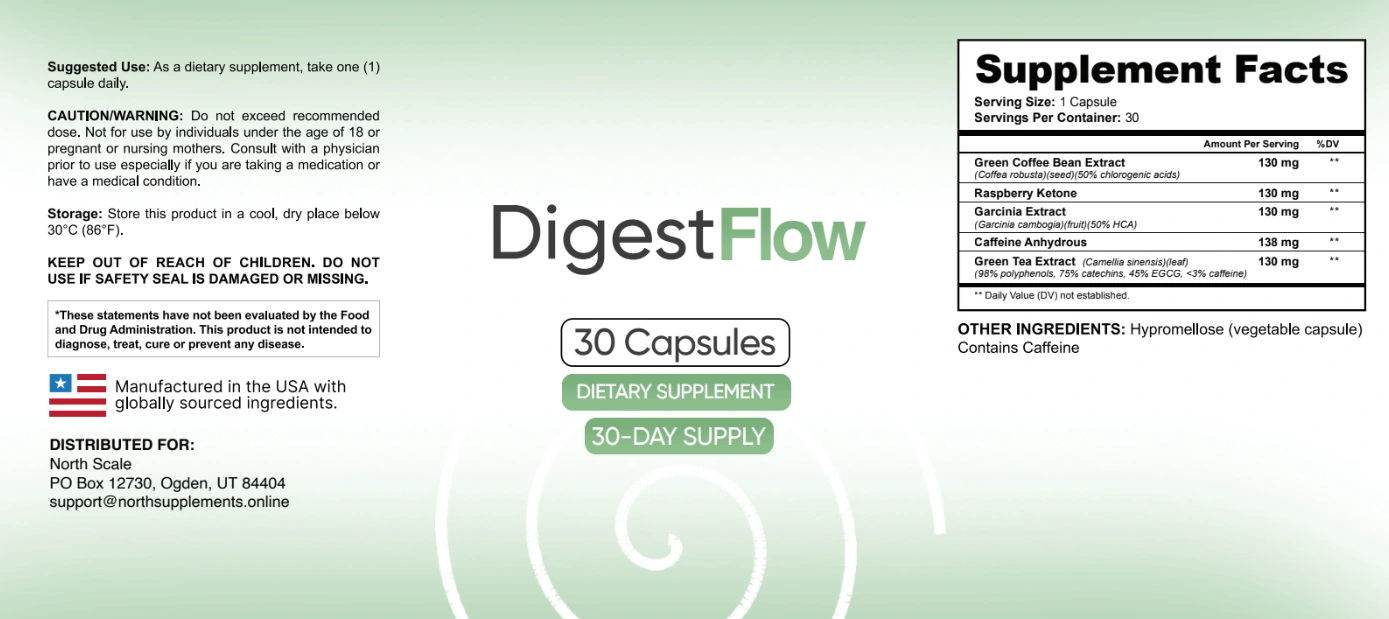
Quick answer: For a DigestFlow missed dose, take the next capsule at the usual time and do not double up. The label says one capsule daily and not to exceed the recommended dose. Two capsules would be 276 mg of caffeine in one go. A missed day matters far less than a moving schedule, so keep the same morning time.
- The retailer’s answer: take the next capsule at the usual time and do not double up.
- The label says one capsule daily and do not exceed recommended dose.
- Two capsules would be 276 mg of caffeine in one dose, against 138 mg for one.
- A late catch-up in the afternoon risks shorter sleep, since caffeine after midday can do that.
- A fixed time matters more than any single missed day.
What is the answer to a DigestFlow missed dose?
The retailer’s FAQ gives it in one sentence. Take the next one at the usual time and do not double up. The how to use page adds the reason: a missed day matters far less than a moving schedule, because a routine you keep shifting cannot be judged.
That is also the answer the label points to. The suggested use is to take one capsule daily, and the caution opens with do not exceed recommended dose. Nothing on the bottle describes a catch-up dose, a half dose or a loading plan. There is no such thing on this label.
Why not double up after a DigestFlow missed dose?
Because of the caffeine. One capsule holds 138 mg of caffeine anhydrous. Two would be 276 mg in a single dose. That is well above what the capsule normally gives you and it arrives all at once.
| Capsules in one dose | Caffeine from the capsules | Comment |
|---|---|---|
| 1 | 138 mg | The label dose |
| 2 | 276 mg | Double, in a single hit; the label says not to exceed the dose |
The FDA cites 400 mg a day as an amount not generally associated with negative effects in healthy adults.
Add your coffee, tea or fizzy drinks and a doubled dose can leave you well over that reference by midday. Doubling also adds twice the green tea extract and garcinia in one go, which does nothing for the missed day and adds a little to the very things the retailer asks you to keep small.
What if you remember the DigestFlow missed dose late in the day?
Leave it. Do not take the capsule in the evening to make up for the morning. The retailer’s timing advice is to take it in the morning, before midday, because caffeine taken even six hours before bed has been shown to cut measured sleep, and people largely do not notice.
So a late catch-up buys you nothing and may cost you sleep. Skip it and take the next one at your usual time the next day. The capsule count in the bottle will be one higher at the end, which is a small thing. A night of lighter sleep is a bigger one, especially since sleep itself moves digestive symptoms.
How should you handle several missed days of DigestFlow?
The label gives no restart rule, and the seller publishes no guidance on gaps. So the sensible default is the same as for one day. Take one capsule at your usual morning time and carry on. Do not catch up and do not double.
If you stopped for several days, the retailer’s testing advice is relevant. A trial is hard to read when the schedule keeps moving. You may prefer to note the gap in your own record, so that when you read your notes at day thirty you know which days counted. And if the gap came from feeling unwell, speak to a doctor before you restart.
Check, then decide at your own pace
A steady routine is easier than it sounds. The order page shows the price and the guarantee before you pay.
See today's price and guaranteeDisclosure: this website is a retailer and earns on the packs it sells. The checkout shows the amount you pay.
How can you make a DigestFlow missed dose less likely?
Tie the capsule to something fixed. Breakfast works well, with a glass of water. Keep the bottle where you will see it but not in a damp or hot spot. Put a note on the calendar if your mornings vary. A once-a-day product has almost no dosing decisions in it. The one decision left is the time of day, so fix it and stop moving it.
A weekly pill organiser is fine for a week at a time. A month in an open compartment undoes the storage instruction. The label’s storage line explains why. For the full routine, see how to take DigestFlow: 5 steps and the how to use page.
Does a DigestFlow missed dose change the 60-day plan?
A little, and mostly in your head. The 60-day window is counted from the date of purchase, not from the number of capsules taken. A bottle holds 30 capsules and the two-bottle pack covers 60 days of daily use, so a few missed days mean a few capsules left over. They do not extend the window.
That is a reason to set a reminder for day fifty. The window closes at sixty from the date of purchase, and nobody remembers on day fifty-nine. If you have missed a lot of days and the trial has become muddy, you can still ring the order line on +1 (877) 257-0710 before day sixty. The guarantee page explains the steps.
When is a DigestFlow missed dose a signal to stop?
If you keep forgetting, ask why. Sometimes the capsule is simply not worth the effort, and that is a fine answer. Sometimes it is a sign that the capsule bothers you, such as light sleep or a racing feeling, and your mind is quietly avoiding it. If so, move it earlier first, add a little food and count your caffeine.
If none of that helps, stop. The label asks anyone with a medical condition or on a medicine to consult a physician first. And new or worsening digestive symptoms, bleeding, fever, pain or unexplained weight change are reasons to be assessed, not reasons to push on with a capsule. The side effects page lists the signs.
Where do these facts come from?
Label figures come from the printed artwork. Prices and policy terms come from the order paperwork, read on 19 September 2026. Reference points come from sources this website already cites:
- Drake et al., caffeine effects on sleep taken 0, 3 or 6 hours before bed: https://pubmed.ncbi.nlm.nih.gov/24235903/
- The FDA’s own caffeine guidance: https://www.fda.gov/consumers/consumer-updates/spilling-beans-how-much-caffeine-too-much
- MedlinePlus on constipation, a plain-language page on digestive symptoms: https://medlineplus.gov/constipation.html
- NCCIH on dietary and herbal supplements: https://www.nccih.nih.gov/health/dietary-and-herbal-supplements
Frequently asked questions
What should I do if I miss a DigestFlow capsule?
Take the next one at the usual time and do not double up.
Can I take two the next day to catch up?
No. Two capsules would be 276 mg of caffeine in one dose, and the label says not to exceed the recommended dose.
What if I remember in the evening?
Skip it. A late dose risks shorter sleep, so take the next capsule at your usual morning time.
Does a missed day matter?
Far less than a moving schedule. A routine you keep shifting is hard to judge.
Does a missed dose extend the 60-day guarantee?
No. The window runs 60 days from the date of purchase.
Where do I read the dose instruction?
On the bottle and on the how to use page: take one capsule daily and do not exceed the recommended dose.
Our view
A DigestFlow missed dose is a non-event if you treat it that way. Take the next capsule at your usual time, do not double, do not catch up in the evening and write the gap in your notes. The label offers nothing more complicated than that, and nothing more complicated is needed.
The bigger risk is not the missed day. It is the moving schedule and the stacked caffeine that follow a panicked fix. Keep the time steady, keep the sum honest and let the 60-day window do its job.
Ready to look at the real terms?
The two-bottle pack covers the 60-day window. The order page shows the packs and the wording.
See today's price and guaranteeDisclosure: this website is a retailer and earns on the packs it sells. The checkout shows the amount you pay.
Last updated . Medically reviewed by Dr. Will Bulsiewicz, MD, Physician.