DigestFlow Official Website › Blog › DigestFlow Honest Review 2026
DigestFlow Honest Review 2026: 7 Checks Scored Out Of Ten
An honest review should say where a product is strong and where it is weak. This one scores DigestFlow on seven checks, uses the seller's own published scoring and flags every place where the evidence stops.
Quick answer: On the seller's own ten-question checklist, DigestFlow averages 7.1 out of 10. It scores highly for printed weights, caffeine disclosure and shell. It scores low for how well the ingredients match a digestive aim, dose match to published work, missing test papers and no single-bottle starter pack.
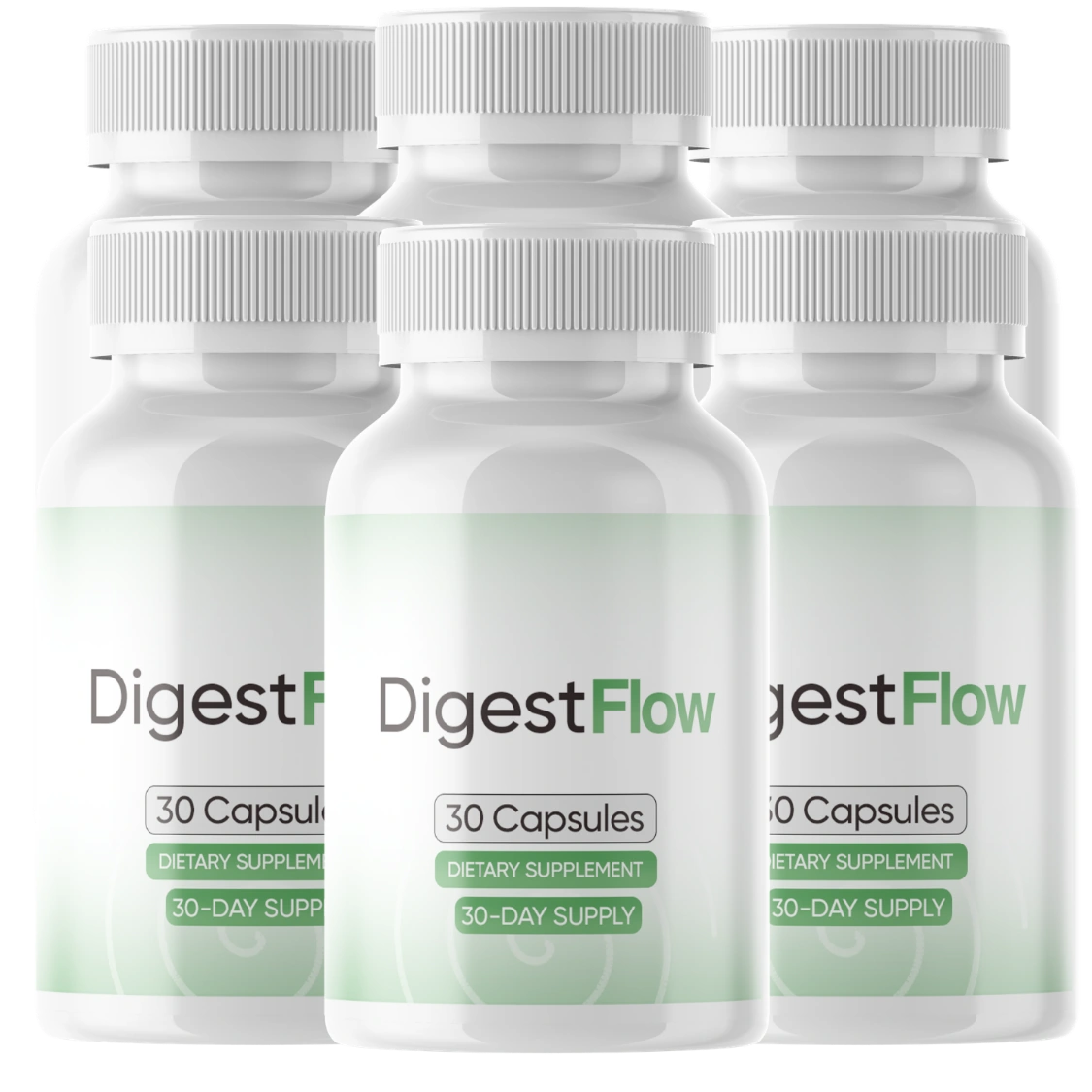
- Seller's own checklist average: 7.1 out of 10 across ten questions.
- High marks: every weight printed, caffeine declared twice, shell named, serving clear.
- Low marks: ingredient match 3 out of 10, published testing 3, dose match 4, starter pack 4.
- No published trial of the finished formula. No weight-loss claim.
- Seller's review file: 4.5 out of 5 across 691 written reviews, a self-reported summary.
- Not FDA approved, as no supplement is.
Check 1: How open is the label?
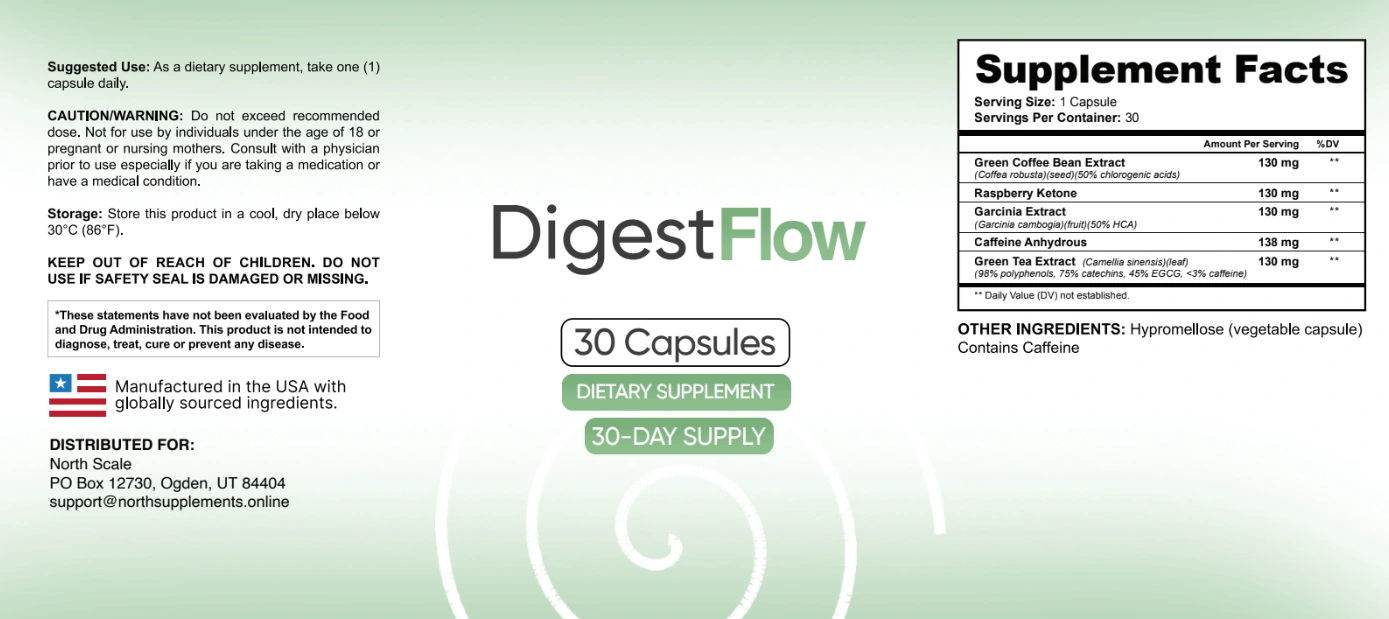
Score: 10 out of 10. Very open. Five rows, five printed weights and no proprietary blend, so the amounts can be compared with published work. Three rows add a standardisation, and the other two are single compounds. The shell is hypromellose, so the vegetarian question is answered on the bottle.
Caffeine is declared twice, once as a 138 mg row and once in a separate Contains Caffeine line. This is better than a lot of the shelf, where caffeine hides inside other rows. The serving is one capsule, there are 30 servings in a bottle, and there is nothing to divide.
Check 2: Do the ingredients match a digestive aim?
Score: 3 out of 10. This is the honest weak point. Green coffee bean extract, raspberry ketone, garcinia and green tea are the usual weight-management set. The label is for digestive wellness. The one row with a measured effect on the intestine is caffeine, and it is one row out of five.
The seller makes the same criticism of its own panel. No study of the finished capsule exists in print, so there is no direct proof that the five together do anything for the gut.
| Row | Per capsule | Evidence in one line |
|---|---|---|
| Green coffee bean extract | 130 mg | Best-known trial retracted in 2014 |
| Raspberry ketone | 130 mg | Rodent work only |
| Garcinia extract | 130 mg | Main trial matched placebo at about 23 times this HCA dose |
| Caffeine anhydrous | 138 mg | Measured effect on colonic activity |
| Green tea extract | 130 mg | Studied mostly for energy use, at higher EGCG doses |
Check 3: Is any dose backed by published work?
Score: 4 out of 10. Partly. A 138 mg caffeine dose is a real dose of a studied substance. Garcinia is the clearest miss: the reference trial gave 1,500 mg of HCA a day, and this capsule has about 65 mg. Green tea studies on energy use usually involve 270 mg of EGCG or more, against about 59 mg here.
That does not make the capsule useless. It means that published results for the single ingredients cannot be carried over to this product. Be wary of any page that does it for you.
Check 4: Is there independent testing?
Score: 3 out of 10. No published certificate. The seller holds a lot reference, DIG-26/GO-2148, and a certificate reference, DIG-2148-26-GO. Both are filing references. The document itself is not published, which is common in this category and still a gap.
Four marks sit on the carton, and three describe the factory rather than the capsule: an FDA-registered facility roundel, a Good Manufacturing Practice seal and a seal for ingredients from foreign and domestic sources. Only the fourth, a money-back seal, is a promise you can act on.
Test it, do not trust it
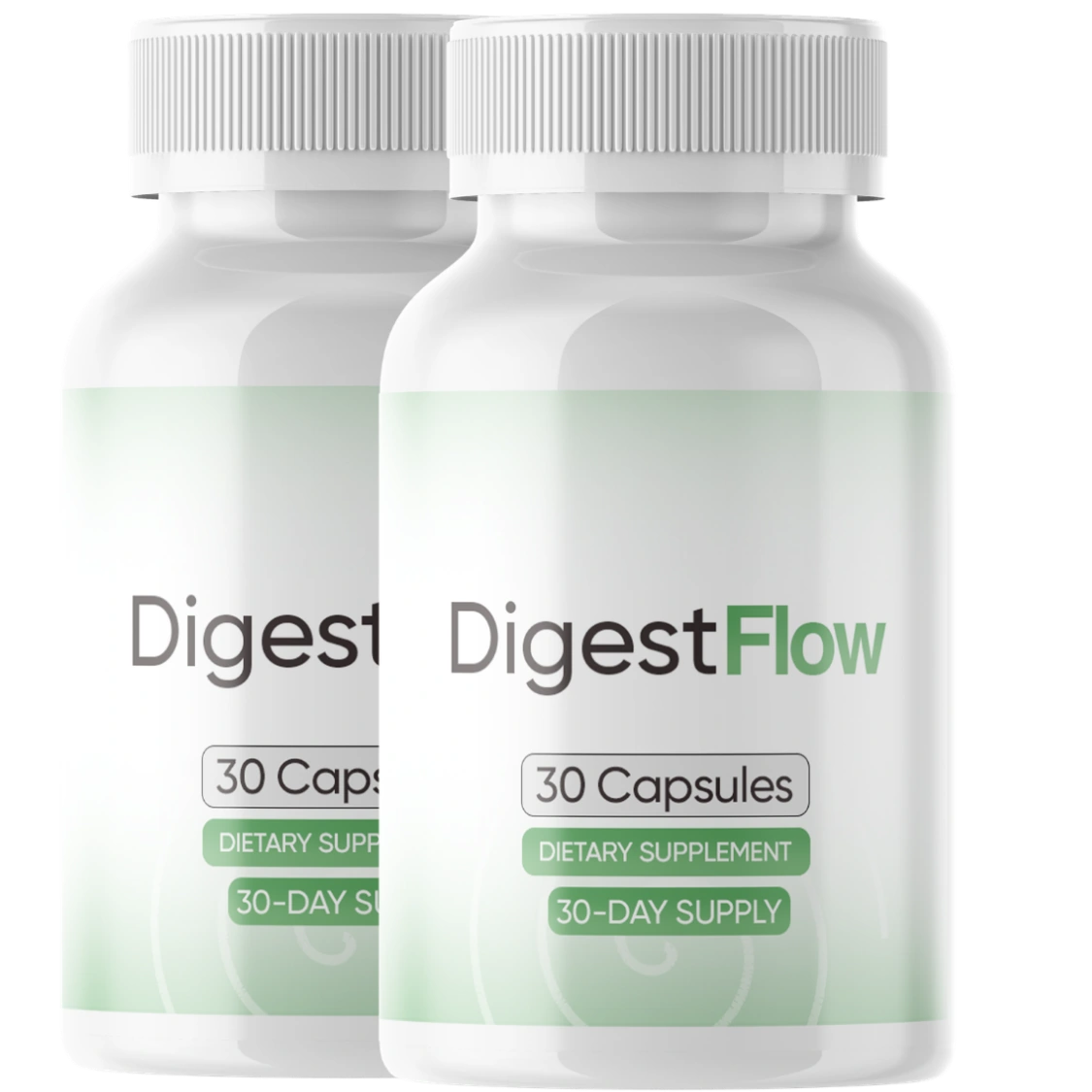
Two bottles cover the full 60-day window at one capsule a day, which is the smallest honest version of the experiment.
See today's price and guaranteeDisclosure: this website is a retailer and earns on the packs it sells. The checkout shows the amount you pay.
Check 5: Is the guarantee usable?
Score: 9 out of 10. Mostly yes. Sixty days is the figure in both documents, and the start date is the only difference: purchase on the supplier sheet, shipping on the seller's own page. Count from the day you paid and ring before day 60. Postage back is yours unless the parcel was damaged, defective or wrong because of the seller.
A point is lost for the two wordings. A small point to the seller's credit: it prints the conflict openly instead of choosing the friendlier date.
Check 6: Is there a small pack to start on?
Score: 4 out of 10. No. The smallest pack is two bottles at $158, or $79 a bottle. The three-bottle pack is $207 and the six-bottle pack $294. A single bottle would make a first decision easier, and the seller scores itself low for the gap.
The 60-day guarantee offsets this only if you use it. Two bottles hold 60 capsules, enough to cover the whole window at one a day.
Check 7: What do the reviews really show?
The seller's file reads 4.5 out of 5 across 691 written reviews and 8,054 orders, with 92% saying they would recommend it. Two thirds gave five stars, and one in twenty gave one or two. These are summary figures compiled by the seller. They are not audited and they are not evidence about the formula.
Eight named buyers are published. Five describe a habit that stuck. Three scored it 3 out of 5, wanted a faster change and stopped. The most common complaint in the file is a slow start. The most common buyer window for noticing anything is week three or four, which is a tally of replies, not a finding.
What is the fair overall score, and who is it for?
The seller's own ten-question average is 7.1 out of 10. It rewards openness and penalises the mismatch between the ingredients and the aim, the missing paperwork and the absent starter pack.
It suits a healthy adult who drinks little caffeine, wants a fixed daily habit and is content to test for 60 days. It does not suit anyone under 18, pregnant or nursing mothers, anyone limiting caffeine, or anyone who wants a probiotic. Medication or a medical condition means asking a physician first.
Frequently asked questions
Is DigestFlow worth buying in 2026?
It depends on caffeine and on fit. On the seller's own checklist it averages 7.1 out of 10: open label, real guarantee, but weak ingredient match and no published testing. Use the 60 days as a test.
What is the biggest weakness of DigestFlow?
The ingredient set. Four of the five actives come from weight-management writing, and only caffeine has a measured effect on the intestine. The finished capsule has no published study.
What is the biggest strength?
Openness. Every active has a printed weight, caffeine is declared twice, the shell is named and the guarantee conflict is shown rather than hidden.
Do the customer reviews prove it works?
No. The seller's summary of 4.5 out of 5 across 691 written reviews is its own, unaudited, and says nothing about whether the formula works.
How long should I try it before deciding?
A full bottle of 30 days is the shortest honest trial. Read your notes at day 30, set a reminder for day 50 and claim before day 60 if it is not for you.
Who should avoid it?
Under-18s, pregnant or nursing mothers, anyone told to limit caffeine and anyone wanting a probiotic. Ask a physician first if you take medication or have a medical condition.
Sources
- Rao SS, Welcher K, Zimmerman B, Read N. Is coffee a colonic stimulant? Eur J Gastroenterol Hepatol. 1998. PMID 9581985: https://pubmed.ncbi.nlm.nih.gov/9581985/
- Latthe A, Tan A, Latthe P. The Effectiveness of Caffeine in Reducing Constipation in Adults: A Systematic Review. 2025. PMID 39666017: https://pubmed.ncbi.nlm.nih.gov/39666017/
- Heymsfield SB, Allison DB, Vasselli JR, et al. Garcinia cambogia (hydroxycitric acid) as a potential antiobesity agent: a randomized controlled trial. JAMA. 1998. PMID 9820262: https://pubmed.ncbi.nlm.nih.gov/9820262/
- Vinson JA, Burnham BR, Nagendran MV. Green coffee bean extract trial in overweight subjects. 2012. PMID 22291473. RETRACTED: https://pubmed.ncbi.nlm.nih.gov/22291473/
- Morimoto C, Satoh Y, Hara M, et al. Anti-obese action of raspberry ketone. Life Sci. 2005. PMID 15862604: https://pubmed.ncbi.nlm.nih.gov/15862604/
- Otaif KD, Adawi HA, Alfaifi FM, et al. Chlorogenic acids and caffeine in commercial green coffee bean extract supplements: quantitative assessment and evidence of mislabelling. 2026. PMID 42154619: https://pubmed.ncbi.nlm.nih.gov/42154619/
- U.S. Federal Trade Commission. Health Claims: advertising and marketing guidance for the supplement industry: https://www.ftc.gov/news-events/topics/truth-advertising/health-claims
- National Center for Complementary and Integrative Health. Dietary and Herbal Supplements: https://www.nccih.nih.gov/health/dietary-and-herbal-supplements
- The DigestFlow label as reproduced on this site
Our view
An honest review of DigestFlow ends in the middle. It is a clear, open label wrapped around a panel that does not obviously match its stated purpose, sold with a guarantee that is real if you use it. We would not call it a miracle and we would not call it a trick.
If the caffeine sum works for you, a first month with notes is a fair test. If not, nothing here should talk you into it. This is general information, not medical advice, and no supplement is FDA approved.
Scores in hand, decide at your own pace
The official page shows today's price and the guarantee terms in one place, with nothing to hurry you.
See today's price and guaranteeDisclosure: this website is a retailer and earns on the packs it sells. The checkout shows the amount you pay.
Last updated . Medically reviewed by Dr. Will Bulsiewicz, MD, Physician.