DigestFlow Official Website › Blog › DigestFlow Green Tea Extract And The Liver
DigestFlow Green Tea Extract And The Liver: 5 Checks Of The Evidence
Green tea extract and liver worries often show up together in search results, and the topic deserves a calm, exact answer. Here are five checks that put the DigestFlow figures next to what the reviews actually describe.
Quick answer: The green tea row in DigestFlow is 130 mg, which works out at about 59 mg of EGCG. Liver reports on green tea extract cluster far above that, above 800 mg of EGCG a day. The garcinia row has separate case reports. Stop and get checked if warning signs appear, and ask a physician first if you have liver disease.
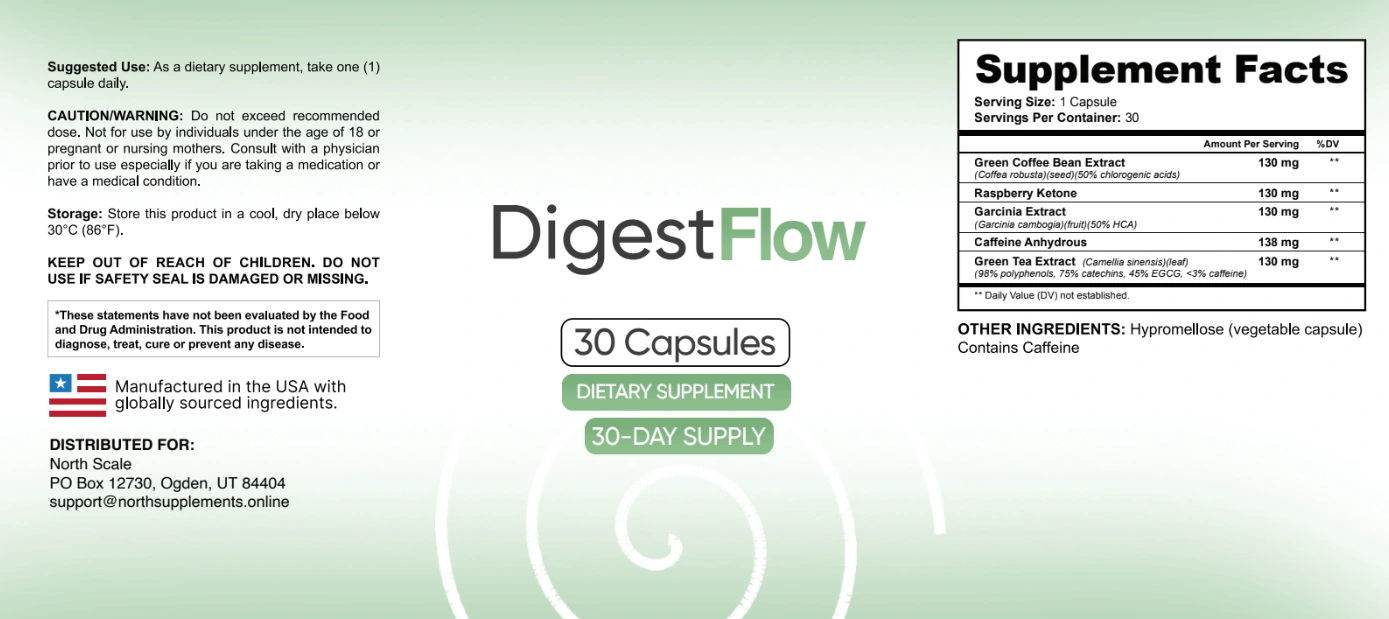
- The green tea row is 130 mg at 45% EGCG, so about 59 mg of EGCG per capsule.
- Liver reports on green tea extract cluster above 800 mg of EGCG a day, which this capsule is far below.
- The garcinia row has case reports of liver injury, mostly in multi-ingredient products at higher doses.
- The label does not say whether to take the capsule fasted or fed.
- Anyone with existing liver disease should know the reports exist, and the label asks for a physician conversation if you take medication or have a condition.
Check 1: What does the green tea row actually hold?
The panel prints green tea extract from Camellia sinensis leaf at 130 mg per capsule. Of the five rows it carries the longest list of percentages: 98% polyphenols, 75% catechins, 45% EGCG and under 3% caffeine.
The sum is short. 45% of 130 mg is about 59 mg of EGCG. That is the figure to hold in mind when you read any liver report, because the reports speak in grams and milligrams of EGCG, not in capsules.
| Figure | Value | How it is worked out |
|---|---|---|
| Extract in one capsule | 130 mg | Printed on the panel |
| EGCG share | 45% | Printed on the panel |
| EGCG per capsule | about 59 mg | 45% of 130 mg, rounded |
| Caffeine from this row | a few mg at most | Under 3% of 130 mg |
Check 2: What do the liver reviews say about green tea extract?
Two reviews matter here. A United States Pharmacopeia review of reported cases located the concern in concentrated extracts taken in large daily amounts, often on an empty stomach. The LiverTox record takes the same line.
Cases of liver injury cluster above roughly 800 mg of EGCG a day. A capsule with about 59 mg is a long way below that. The NCCIH page on green tea gives a general reader the wider picture.
This is not a promise that nothing can happen. It is a statement about where the published reports sit. The honest reason to know the number is stacking. Green tea extract turns up in many products, and the totals add together.
A safe-looking dose in one capsule can become a large dose once a second product with green tea extract is added. If you take anything else with green tea in it, add the EGCG figures before you start.
Check 3: What about the garcinia row in the same capsule?
Garcinia is the row with the more worrying case literature. Published reports describe liver injury linked to garcinia products, including acute liver failure and one case that needed a transplant. The LiverTox record collects them and notes that most involve multi-ingredient products at higher doses.
The garcinia row here is 130 mg at 50% HCA, so about 65 mg of hydroxycitric acid. The one reference trial used 1,500 mg of HCA a day for twelve weeks and found no difference from placebo, so there is no efficacy case to weigh against the safety reports.
Because this is a multi-ingredient capsule, the reports are relevant to read, even though the dose is lower. Anyone with liver disease should know the reports exist before taking any product with garcinia in it.
Read the whole panel first
The official page shows every figure on the label, the price and the 60-day terms before you pay.
See today's price and guaranteeDisclosure: this website is a retailer and earns on the packs it sells. The checkout shows the amount you pay.
Check 4: Does it matter if you take it on an empty stomach?
The label does not specify. The reports on green tea extract describe large daily amounts, often taken fasted, which is a different situation from one 59 mg portion. Still, there are two plain reasons to add a little food.
First, 138 mg of caffeine can feel sharp on an empty stomach, and a small number of people get a jittery half-hour or nausea. Second, taking the capsule with a bite of breakfast costs nothing and removes a variable. Water, not coffee, is the better drink for swallowing it.
Keep the timing in the morning, and keep it the same each day. That also makes any change easier to spot and report.
Check 5: What are the warning signs, and when do you stop?
The liver case literature describes a small set of signs. They are uncommon, and they are not a reason to avoid the product. They are a reason to stop taking it and get looked at, rather than wait and see.
- Yellowing of the skin or the eyes.
- Dark urine.
- Pale stools.
- Nausea that does not go away.
- Pain on the right side of the upper belly.
- Unusual tiredness.
Ring a doctor, not the order desk, for these. The order desk can handle a refund, but it cannot advise on symptoms. If you take any medication or have a medical condition, the label asks you to consult a physician before use. Take the bottle so the panel can be read.
Gut symptoms have many causes. A capsule cannot tell you which one you have, so anything that persists or worries you belongs with a clinician.
How do the numbers in this capsule compare in one view?
| Row | Per capsule | What the safety literature says | Position here |
|---|---|---|---|
| Green tea extract | 130 mg, about 59 mg EGCG | Reports cluster above 800 mg of EGCG a day | Far below |
| Garcinia extract | 130 mg, about 65 mg HCA | Case reports, mostly multi-ingredient products at higher doses | Lower dose, but read the reports |
| Caffeine anhydrous | 138 mg | Counts toward the daily total | About a third of 400 mg |
These are published patterns, not adverse-event data collected on this product.
Frequently asked questions
Is the green tea extract in DigestFlow bad for the liver?
Liver reports on green tea extract cluster in large daily amounts, above about 800 mg of EGCG a day. One capsule holds about 59 mg. Stacking with other green tea products is the reason to know the number.
Should I take DigestFlow on an empty stomach?
The label does not say. The liver reports describe large amounts, often fasted. A little food is a sensible default, because 138 mg of caffeine can feel sharp when fasted.
What are the liver warning signs I should know?
Yellowing of the skin or eyes, dark urine, pale stools, persistent nausea, right-sided abdominal pain or unusual tiredness. Stop taking the capsule and get checked rather than wait and see.
Is the garcinia in DigestFlow linked to liver problems?
Case reports link garcinia products to liver injury, mostly in multi-ingredient products at higher doses. The row here is 130 mg at 50% HCA. Anyone with liver disease should know the reports exist.
Can I take DigestFlow with other green tea supplements?
Add up the EGCG first. Green tea extract appears in many products, and the amounts combine. Ask a physician if you are unsure, as the label asks you to if you take medication.
Has DigestFlow been tested for liver safety?
Nobody has trialled the finished formula. The reviews cited here cover the single ingredients, not this capsule.
Sources
- Oketch-Rabah HA, Roe AL, Rider CV, et al. United States Pharmacopeia (USP) comprehensive review of the hepatotoxicity of green tea extracts. Toxicol Rep. 2020. PMID 32140423: https://pubmed.ncbi.nlm.nih.gov/32140423/
- LiverTox: Clinical and Research Information on Drug-Induced Liver Injury. Green Tea. NIDDK: https://www.ncbi.nlm.nih.gov/books/NBK547925/
- National Center for Complementary and Integrative Health. Green Tea: https://www.nccih.nih.gov/health/green-tea
- LiverTox: Clinical and Research Information on Drug-Induced Liver Injury. Garcinia Cambogia. NIDDK: https://www.ncbi.nlm.nih.gov/books/NBK548087/
- Corey R, Werner KT, Singer A, et al. Acute liver failure associated with Garcinia cambogia use. Ann Hepatol. 2016. PMID 26626648: https://pubmed.ncbi.nlm.nih.gov/26626648/
- Lunsford KE, Bodzin AS, Reino DC, et al. Dangerous dietary supplements: Garcinia cambogia-associated hepatic failure requiring transplantation. World J Gastroenterol. 2016. PMID 28018115: https://pubmed.ncbi.nlm.nih.gov/28018115/
- Heymsfield SB, Allison DB, Vasselli JR, et al. Garcinia cambogia (hydroxycitric acid) as a potential antiobesity agent: a randomized controlled trial. JAMA. 1998. PMID 9820262: https://pubmed.ncbi.nlm.nih.gov/9820262/
- The DigestFlow label as reproduced on this site
Our view
On the numbers, the green tea row is small. About 59 mg of EGCG sits well under the region the liver reports describe. That is reassuring, and it is also not a guarantee, because bodies differ and products stack.
Our view: the garcinia reports deserve more respect than the green tea ones, and anyone with liver disease should talk to a physician before using any product with either extract. For everyone else, take one capsule in the morning with a little food, know the warning signs and use the 60-day window if anything feels wrong. This is general information, not medical advice.
Know the numbers before you buy
If the figures sit comfortably with you and your physician, see today's price and guarantee.
See today's price and guaranteeDisclosure: this website is a retailer and earns on the packs it sells. The checkout shows the amount you pay.
Last updated . Medically reviewed by Dr. Will Bulsiewicz, MD, Physician.