DigestFlow Official Website › Blog › Are Probiotic Supplements Worth It
Are Probiotic Supplements Worth It? 6 Checks Before You Buy One
Probiotic supplements fill whole shelves, and the questions people ask are fair: do they work, are they safe, how should you take them? This page cannot settle those. It gives six checks that help you read any probiotic label, and shows where a caffeine capsule like DigestFlow sits by comparison.
Quick answer: A probiotic adds live organisms, strain by strain. The National Center for Complementary and Integrative Health says effects depend on strain, dose and condition, and a good result for one strain tells you little about the next. Check named strains, a CFU count and a clear serving. DigestFlow is not a probiotic.

- A probiotic works by adding live organisms, and the evidence is strain-specific and narrow.
- A useful label names the strain, gives a CFU count and states the serving.
- A panel that names a genus without a strain does not tell you enough to look anything up.
- A prebiotic is different: it feeds organisms already present.
- This site publishes no safety or side-effect figures for probiotics. Read the NCCIH page and ask a clinician.
- DigestFlow has no probiotic, no enzyme and no fibre on its panel.
Check 1: What is a probiotic supplement, and how is it different?
A probiotic supplement adds live organisms. Digestive supplements fall into five groups that act in different ways: fibres add bulk and hold water, enzymes act on a meal, probiotics add organisms, bitters and carminatives act on secretion and gas, and stimulants act on motility.
| Group | How it acts | Typical form | Where it is weak |
|---|---|---|---|
| Fibre | Adds bulk and holds water | Psyllium, inulin, glucomannan, by the gram | Speed and taste |
| Enzymes | Act on the meal | Protease, lipase, amylase, lactase, with food | Doing anything between meals |
| Probiotics | Add live organisms | Capsules with a CFU count and named strains | Generalising; evidence is strain-specific |
| Bitters and carminatives | Traditional action on secretion and gas | Ginger, peppermint, fennel, gentian | Modern trial evidence |
| Stimulants | Act on motility | Senna, cascara, magnesium salts, caffeine | Long-term use without consequence |
Mechanisms, not a league table.
Most disappointment comes from buying one group while expecting another. Decide which group you actually want before you compare brands.
Check 2: Do probiotic supplements work?
Sometimes, and for narrow things. The NCCIH page on probiotics is candid that effects are specific to strain, dose and condition. A good result for one strain says very little about another strain, or about a product that bundles many.
So a vague claim that a probiotic is good for you is a weak starting point. A better question is: which strain, at what dose, studied for what? If a bottle cannot tell you, you cannot look it up, and you cannot know whether the evidence applies.
We will not state efficacy figures here. This site does not publish any for probiotics, and inventing one would be worse than the gap.
Check 3: What should a probiotic label show?
Four things you can check in under a minute.
- Named strains, not just a genus. A genus alone is not enough to look anything up.
- A CFU count, which stands for colony forming units and counts the live organisms. A probiotic without one is not telling you the dose.
- A clear serving size, so you can work out how many days a bottle lasts.
- An other-ingredients line, which also answers the vegetarian question about the capsule shell.
Add one habit from the wider category: check for hidden caffeine in any digestive product. It can appear inside green tea or guarana rows, or only as a Contains Caffeine line.
Check 4: Are probiotic supplements safe, and can they cause gas or stomach upset?
This site publishes no safety figures or side-effect rates for probiotics, so it will not give you a list. The honest advice is to read the NCCIH page on probiotics, which is written for readers rather than for sellers.
A general rule applies to any new supplement. If you notice stomach pain, diarrhoea or gas that is new, strong or lasts, stop and speak to a clinician. If you take medication or have a medical condition, ask first. That is what the DigestFlow label also asks of its own buyers.
People with symptoms that carry bleeding, fever, persistent pain or unexplained weight change need an examination, not a new bottle.
If you want a stimulant-led capsule instead
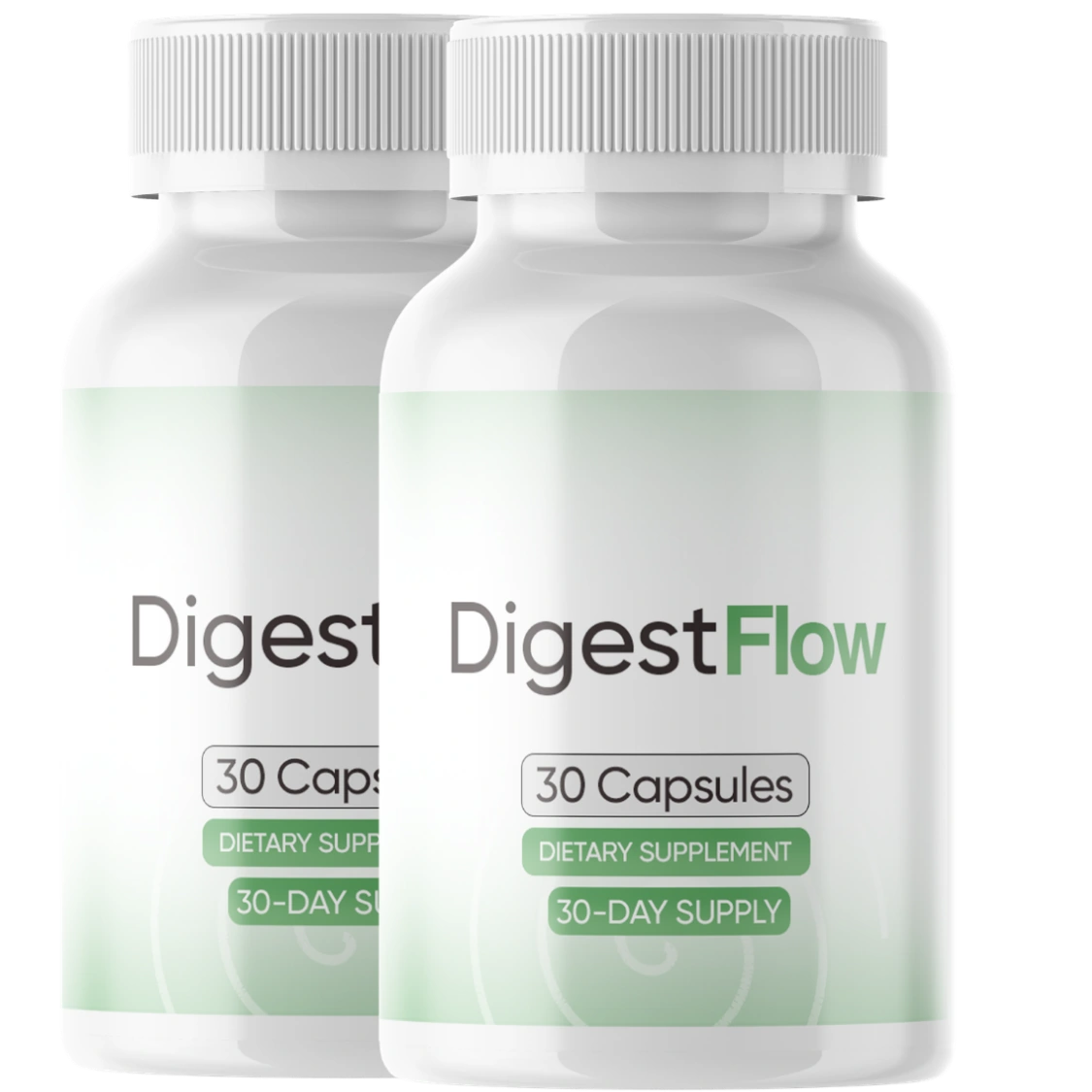
DigestFlow is not a probiotic. The official page shows its printed panel, the packs and the 60-day guarantee.
See today's price and guaranteeDisclosure: this website is a retailer and earns on the packs it sells. The checkout shows the amount you pay.
Check 5: How often, when and how should you take probiotic supplements?
Follow the label of the product you buy. Timing, dose and storage differ from product to product, and this site has no figures to offer for them. Do not copy a routine from one brand to another.
Whatever you take, change one thing at a time and keep notes. If you start two new products in the same week, you cannot tell which did what. That advice holds for DigestFlow and for a probiotic alike.
Check 6: Where does DigestFlow sit next to a probiotic?
It is a different thing. DigestFlow is a once-a-day capsule with five printed actives, 658 mg in total. There is no bacterial strain, no digestive enzyme and no fibre. The only row with a measured effect on the intestine is caffeine anhydrous, 138 mg, which acts on motility.
The seller's own pricing page puts a well-studied probiotic at roughly $0.80 to $2 a day, as an ordinary retail range, and notes that it is a different mechanism entirely. If a live culture is what you want, a DigestFlow order is the wrong purchase, and the seller says so.
| Question | A probiotic | DigestFlow |
|---|---|---|
| Main mechanism | Adds live organisms | Stimulant row (caffeine) plus four extracts |
| Dose unit on label | CFU and named strains | mg per capsule, five weights printed |
| Contains caffeine | Check the label | Yes, 138 mg a capsule |
| Capsule shell | Check the label | Hypromellose |
Frequently asked questions
Are probiotic supplements worth it?
It depends on the strain, the dose and what you want from it. NCCIH says effects are specific to strain, dose and condition. A label with named strains and a CFU count lets you check.
Do probiotic supplements work?
Some do, for narrow uses. A result for one strain says little about another. This site publishes no efficacy figures for probiotics.
What does CFU mean on a probiotic?
Colony forming units, the count of live organisms. A probiotic that gives no CFU count is not telling you the dose.
Can probiotic supplements cause gas or stomach pain?
This site publishes no side-effect figures for them. If new or lasting symptoms appear after starting any supplement, stop and speak to a clinician.
Is DigestFlow a probiotic?
No. Its panel carries no bacterial strain, no enzyme and no fibre. It is a caffeine-led capsule with four plant or synthesised extracts.
Is a prebiotic the same as a probiotic?
No. A prebiotic is a substrate that feeds organisms already living in the gut. A probiotic adds the organisms. The two are often confused.
Sources
- National Center for Complementary and Integrative Health. Probiotics: What You Need To Know: https://www.nccih.nih.gov/health/probiotics-what-you-need-to-know
- National Center for Complementary and Integrative Health. Dietary and Herbal Supplements: https://www.nccih.nih.gov/health/dietary-and-herbal-supplements
- National Institute of Diabetes and Digestive and Kidney Diseases. Your Digestive System and How It Works: https://www.niddk.nih.gov/health-information/digestive-diseases/digestive-system-how-it-works
- National Institute of Diabetes and Digestive and Kidney Diseases. Irritable Bowel Syndrome (IBS): https://www.niddk.nih.gov/health-information/digestive-diseases/irritable-bowel-syndrome
- The DigestFlow label as reproduced on this site
Our view
Probiotic supplements are worth considering only when the label lets you check what you are buying. Named strains, a CFU count and a clear serving are the minimum. Anything vaguer asks you to take the claim on trust.
We would also keep the groups apart in your mind. A live culture, an enzyme, a fibre and a stimulant do different jobs. This page is general information, not medical advice, so talk to a doctor if you take medication, have a medical condition or have symptoms that persist.
Know which shelf you are shopping on
If a once-a-day capsule with 138 mg of caffeine is what you are after, the official page shows today's price and terms.
See today's price and guaranteeDisclosure: this website is a retailer and earns on the packs it sells. The checkout shows the amount you pay.
Last updated . Medically reviewed by Dr. Will Bulsiewicz, MD, Physician.